Script / Continuity
Script Supervisor Notes Template
Free script supervisor template (PDF): log scene, setup, take, roll, lens, sound roll, MOS/sync and circled takes. Landscape, no signup.
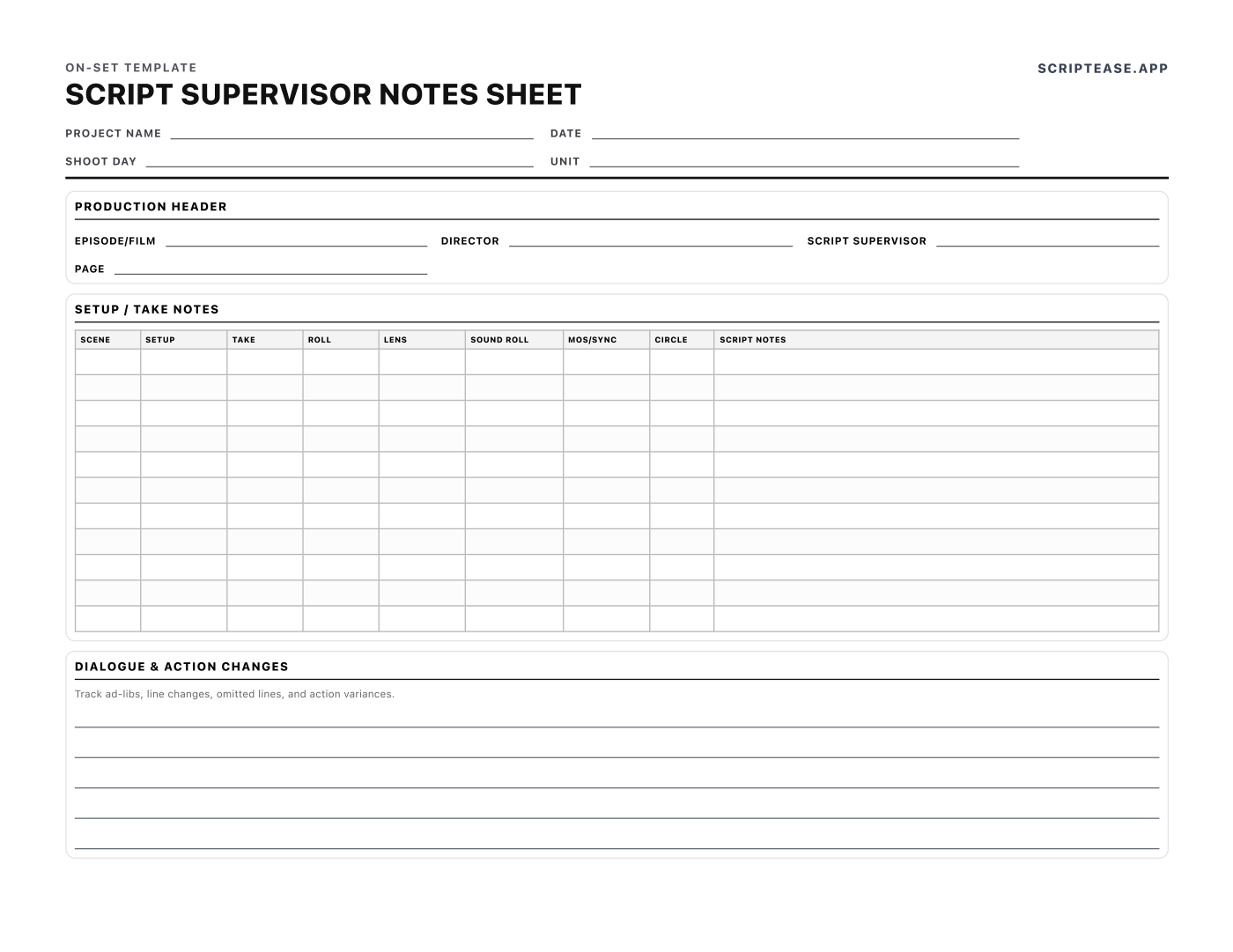
This free script supervisor template — the script supervisor sheet some crews just call "the notes" — is the one the editor will thank you for. Every setup, every take, what lens it was on, whether it was sync or MOS, and which ones the director circled — it all lands here, take by take, while the floor moves faster than your handwriting. It's one of five script supervisor templates we give away free.
The dialogue and action block at the bottom matters more than it looks. Ad-libs, dropped lines and action that drifted from the page are the notes that stop a scene from failing to cut together weeks later, long after everyone has forgotten what actually happened on the day.
How to fill in the script supervisor notes
- Fill in the production header once per page: film or episode, director, your name and the page number.
- Log every take on its own line: scene, setup, take number, camera roll, lens and sound roll. Mark MOS takes and anything shot without sync.
- Circle the takes the director calls for, and write why a take was NG (camera, sound, performance) so editorial does not have to guess.
- Record script changes as they happen in the dialogue and action changes block: ad-libs, cut lines, swapped words and any action that differs from the page.
- Note timings for scenes that run long or short against the page count; it feeds the daily progress report.
- At wrap, check the roll and sound numbers against the camera and sound reports before the notes go to editorial.
What's on this sheet
- Production header — Episode or film, director, script supervisor and page.
- Setup / take notes — Scene, setup, take, roll, lens, sound roll, MOS/sync, circle and script notes.
- Dialogue & action changes — Ad-libs, line changes, omitted lines and action variances.
Script Supervisor Notes example
Two takes of one setup, logged as they would be on the day:
| Field | Filled in |
|---|---|
| Header | THE QUIET HOUR · Dir. J. Ortiz · Script sup. K. Lee · page 4 |
| Scene / setup / take | 12B / 1 / 3 |
| Roll / lens / sound roll | A004 / 50mm / S002 |
| Sync / circle | Sync · circled |
| Notes | Best performance. Mara says "just leave it" instead of "leave it there" — director happy. |
| Scene / setup / take | 12B / 1 / 4 — A004 / 50mm / S002 · NG camera (focus buzz on the note) |
Example values from a fictional production.
Common mistakes
- Marking a take NG without the reason — editorial needs to know whether the problem was performance or technical.
- Not noting line changes on the take where they happen, so the edit uses a take that contradicts the next scene.
- Letting roll numbers drift from the camera report.
- Leaving MOS takes unmarked, which costs the editor time hunting for sound that does not exist.
Free to download and use on any production, commercial or not. No attribution required, no signup. Please don't resell them or repackage them as your own.
More script supervisor forms
See all five together, with when each is used: script supervisor templates.